

Scales Galore!
- Sonia Rodriguez

- Mar 19, 2021
- 5 min read
In this lesson we will cover the various different types of scales and how to construct them.

What will be covered:
Common scales (aka major & minor scale review)
Chromatic Scales
Whole Tone Scales
Pentatonic Scales
Blues Scales
1) Common Scales
When I refer to common scales I am mainly referring to our major and minor scales that I have talked about in previous lessons. Just in case you forgot or are new and therefore have no idea what I’m talking about, I will do a review on both of these scales.
Major Scale
The major scale is defined by the unique combination it takes to build this scale. The unique combination will from now on be referred to as a formula and this formula uses a combination of whole steps and half steps in order to create the major scale sound. The formula looks something like this:
WHOLE - WHOLE - HALF - WHOLE - WHOLE - WHOLE - HALF

This scale has a characteristic of sounding more upbeat, optimistic. Very much a happy sounding scale that is part of a larger group of scales known as church modes or Greek scales.
Minor Scale
The minor scale is also defined by the unique formula that helps create its sound. What sets the major and minor scale apart though, is the third scale degree. In a minor scale, the third scale degree, the third note is flattened. Because of this, the formula for a minor scale looks like this:
WHOLE - HALF - WHOLE - WHOLE - HALF - WHOLE - WHOLE

The minor scale that follows this particular formula is also known as a natural minor scale and has more of a sad or gloomy sound to it. Altogether there are three types of minor scales but we will cover these, along with the the church modes, in a later lesson.
Both the major and minor scales are known as diatonic scales.
A diatonic scale lets you know that the scale has a designated key in which the very first note is the tonic, the home base. The characteristics of a diatonic scale is that they have seven notes comprised of two half steps and five whole steps.
** Please feel free to count how many half and whole steps are in the formulas above :D **
2) Chromatic Scales
Unlike any other scale that uses about 5-7 notes, the chromatic scale uses 12 notes!
I know, I know, you’re probably thinking that there were only seven notes! I know, me too! But college taught me that I was wrong. :/ Haha.
Well, technically there are seven letters that help us build the musical alphabet but those same seven letters of the musical alphabet can hep us create the 12 musical notes that are used in music! How cool is that! It’s kind of like that story about 3 or 5 fishes and loafs of bread that miraculously turned into like thousands! :O


This is the part of the lesson where I will become a little nerdy by throwing in some Greek translations.
In Greek, the word ‘chroma’ means color and in music the word chromatic is used to indicate that we are using elements of the chromatic scale in order to add color or embellishments to the melodies we are playing or creating.
You might be wondering if there is a formula for creating the chromatic key just like there was a formula for the major and minor scale, huh? Well, unlike the major and minor scale which use a combination of whole and half steps to create its sound, if you look at the illustration above, a chromatic scale is created by moving up or down a half step for all twelve notes.
3) Whole Tone Scales
Much like the name indicates, in a whole tone scale all the notes are a whole step apart but unlike the major or minor scale though, the whole tone scale only uses six notes. This scale is quite unique too as there are really only two whole tone scales.
C Whole Tone Scale


and
Db Whole Tone Scale


Due to its nature of being a whole step apart, it doesn’t matter where on the C Whole Tone Scale you start, you will always end up with the same exact notes on repeat. The same goes for the Db Whole Tone Scale. It is for this reason there are really only two scales, the order may change but you will continue to use the same exact notes. A never changing pattern no matter where you start. Other scales on the other hand, due to their formulas will change based on where on the scale you start.
4) Pentatonic Scales
The pentatonic scales consists of five notes, five scale degrees, which is the reason they are called pentatonics (the scale, not the a cappella group pentatonix, they consist of five members too though).
In Greek, the word ‘penta’ means five so this is the reason why they are called pentatonic scales.
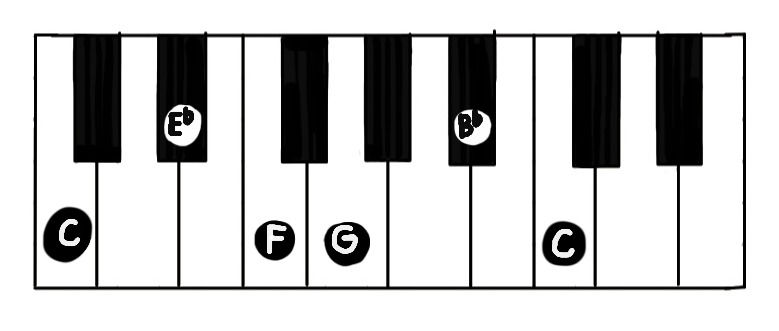
There are different types of pentatonic scales but for this lesson we will focus on the two common pentatonic scales, the major and minor pentatonic scales.
Major Pentatonic Scale
The major pentatonic scale is made up by using the following scale degrees from the major scale:
1st - Tonic
2nd - Supertonic
3rd - Mediant
5th - Dominant
6th - Submediant


Minor Pentatonic Scale
The minor pentatonic scale is a bit different as it uses the following scale degrees from the minor scale:
1st - Tonic
3rd - Mediant
4th - Subdominant
5th - Dominant
7th - Subtonic
** Notice how our 7th scale degree is being referred to as a subtonic because we are making use of the minor scale as opposed to a major scale in which the 7th scale degree is known as the leading tone. **

5) Blues Scales
Oh the blues scales! Probably one of my favorite scales of all time. :)
The blues scales has a lot of similarities with the pentatonic scale as it makes use of a major and minor blues scale. Out of these two though, the most commonly used is that sultry minor blues scale.
Both the major and minor blues scale use the major and minor pentatonic scale base plus an added note known as the blues note. For our major blues scale that added note is a flatted 3rd degree and for our minor blue scale we have a flatted 5th degree.
Major Blues Scale
Use the major pentatonic scale plus the flat 3rd in the following order:
1st - Tonic
2nd - Supertonic
Flat 3rd - Blues Note
3rd - Mediant
5th - Dominant
6th - Submediant


Minor Blues Scale
Use the minor pentatonic scale plus the flat 5th in the following order:
1st - Tonic
3rd - Mediant
4th - Subdominant
Flat 5th - Blues Note
5th - Dominant
7th - Subtonic


There you have it everyone, a quick guide through some of the various scales we can come across in music. Have fun playing with the formulas and creating your own scales. Listen for their unique characteristic and let me know which one is your favorite in the comments section below.
Have fun practicing! :)


Comments