

Greek Modes
- Sonia Rodriguez

- Apr 2, 2021
- 4 min read
Long ago in the far away land of Ancient Greece was a golden age of powerful gods and extraordinary heroes. The greatest and strongest of all these heroes was the mighty Hercules... Oh wait, we’re talking about modes, not Hercules. From Greek modes to church modes, it’s all just scales! :)

What will be covered:
Short History of Greek Modes
The Greek Modes
How Modes Are Formed
1) Short History of Greek Modes
Before we had the theoretical concept of scales there were modes, which originated in ancient Greece and it is for this reason that the names of the modes are Greek. In fact, the names of the modes represent different regions within and outside borders of Ancient Greece.
Since back in those days they did not have the concept of scales people still needed a form of identifying the distance between the tonic note and the upper tonic, for example, from tonic C to the C an octave above. The need for identifying those distances between intervals is what created what we now know as modes and eventually leads to the creation of scales as we now know them.
As time went on intonation changed and the ideas of what sounded good or bad became associated with the forces of good and evil. This said, certain dissonant sounds became known as devil intervals and such so the church banned them. Due to such ideas from the church in those medieval times, the Greek modes went through a change that involved a more pleasing sound and that’s how we ended up with church modes. Later on even these modes go through an alteration as certain sounds become more pleasing to the ears of some composers than other and thereby scales as we now know them were born.
Alrighty, enough of the history, let’s get on with the modes.
2) The Greek Modes
There are a total of seven Greek modes. Within those modes, based on the way they sound, we have modes that are considered to be major, minor and some ambiguous ones. As mentioned earlier the modes were names after regions within and outside the borders of Ancient Greece.
Ionian (Major Scale)
Dorian
Phrygian
Lydian
Mixolydian
Aeolilan (Natural Minor)
Locrian
3) How Modes Are Formed
In order to understand how to create a mode, from here on forth we will be using the C major scale as an example.
The C major scale looks something like this:


Having the C as our starting point, if we wanted to identify the distance between the tonic C and the upper tonic C using the Greek modes, we would call that initial mode the Ionian mode. In terms of scales, the Ionian mode is usually known as your major scale.

Alrighty, moving on. Let’s continue using the pattern of our C major scale but now we want to measure the distance between the supertonic D, to the D an octave above. Remember, we are not changing anything, we are not adding any accidentals to this octave scale, we are keeping it as is. So, from the supertonic D to the D an octave above, using the Greek modes, we would identify it as the Dorian mode.


Using the same pattern found in the C major scale we are now going to try to identify the distance between our median E to the E an octave above. Using our Greek modes we would identify it as the Phrygian mode.


Continuing to use the same pattern without adding any accidentals to the C major scale, we are now going to identify the distance between our subdominant F to the F an octave above. We now have our Lydian mode.


Do you see a pattern here? If not, no worries, here are more examples.
Let’s say we want to identify the distance from our dominant G to the G an octave above using the pattern found in our C major scale. Well, using the Greek modes we would describe the distance of our dominant G, our fifth scale degree, to the G an octave above as the Mixolydian mode.


If we want to identify the submediant A to the A an octave above, using the same pattern found in our C major scale without adding any accidentals, we would identify this distance as the Aeolian mode. The Aeolian mode created using any major scale is also known as the natural minor scale.

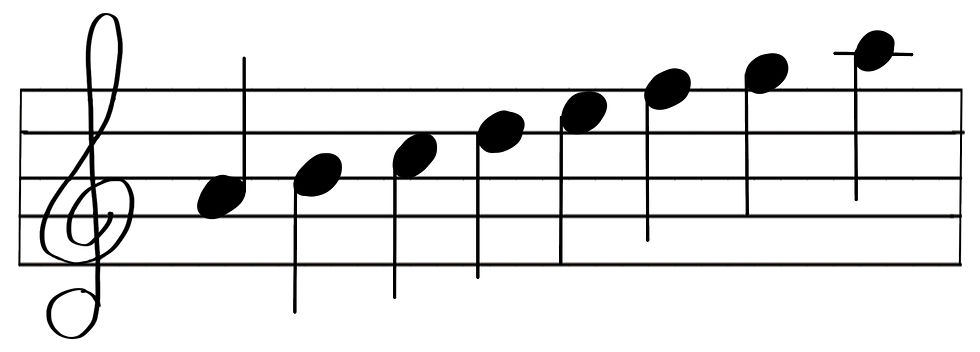
Finally, what if we wanted to identify the distance of our seventh scale degree, our leading tone B to the B an octave above? You got it, using our Greek modes we would identify that distance as the Locrian mode.


In all honesty you can create modes using any major or minor scale. Just don’t add or take away any accidentals and continue following that pattern already established. From there you are just measure the distance of your seven scale degrees to their perspective octaves above. The distance from your first scale degree will be your Ionian mode. The distance from your second scale degree will be your Dorian mode. The distance from your third scale degree will be your Phrygian mode and so forth with the remaining scale degrees.
Now, one thing you should know, this is how we now understand modes to be but the sounds we are probably getting are not the same as those originally heard by the ancient Greeks who came up with this concept of identifying distances between octaves. The reason being is because as times changed and evolved, so did our perspective of what sounds good which in turn also led to the transformation of instruments such as the piano, guitar and so on.
So there you have it everyone, the Greek modes. Try them out, play around with different major and minor scales and see what sounds you get.
As always, happy practicing!


Comments