

Key Signatures
- Sonia Rodriguez

- Jun 16, 2020
- 4 min read
Have you taken a look at a piece of sheet music recently and wondered... "why is there a hashtag there?" Or have you noticed those semi-slanted tiny 'b's on there too? In this lesson you'll learn how these hashtags (and tiny 'b's) play a role in musical key signatures in order to help you read music.

Key Signatures
Key signatures are a collection of accidentals that help us determine in which key the music is written.
In order to understand and learn how to read key signatures we need to know a few basics.
Where do we find the key signature on the staff?
What are accidentals?
How do we use these accidentals in scales?
How do we write key signatures on a staff?
Let's begin.
1) Where do we find the key signature on the staff?

Key signatures are usually found written after the clef at the beginning of the staff.
There are occasions when a change in key occurs and you will encounter key signatures written at the start of a new measure.
2) What are accidentals?
In the above definition of a key signature I described it as being a collection of accidentals. You might be wondering what these accidentals are. Remember those hashtags I alluded to earlier? Well, those hashtags, in music, are actually accidentals.
Accidentals are written in front of musical notes in order to indicate whether that note will be raised from its natural pitch to create a sharp (#) or if it will be lowered to create a flat (b).

For the above example we are going to use our imaginations. That first quarter note we see is our original key with whatever imaginary pitch you assign to it. The note after that has an arrow pointing upwards to indicate that we are raising the natural pitch higher, the way we show that we are raising it from its natural pitch is by adding a sharp (#) in front of the note. Lets say we want our sharp to go back to it's natural pitch, now we would have to lower our sharp back down by putting a natural symbol in front of our note to indicate that we have gone from sharp back down to its original pitch. Once we are back to it's natural pitch, if we wanted that sound to go down by a step then we would place a flat (b) in front of that note to indicate that our sound has now gone a step lower from it's original pitch.
3) How do we use these accidentals in scales?

This would be an example on how we would use accidentals in a scale. If we take the E major scale, which has four sharps (F#, G#, C#, D#), we would place our accidental in front of the note representing our F, G, C, and D. In order to know how many sharps or flats to use in a scale we have to know how to many sharps or flats can be found for each scale. One way that is traditionally taught in school is by learning the circle of 5ths but for the purposes of this particular lesson I am going to give you a list rather than go through the circle of 5th. I will cover that in a different lesson where I will also go over tips on how to memorize the order of accidentals.
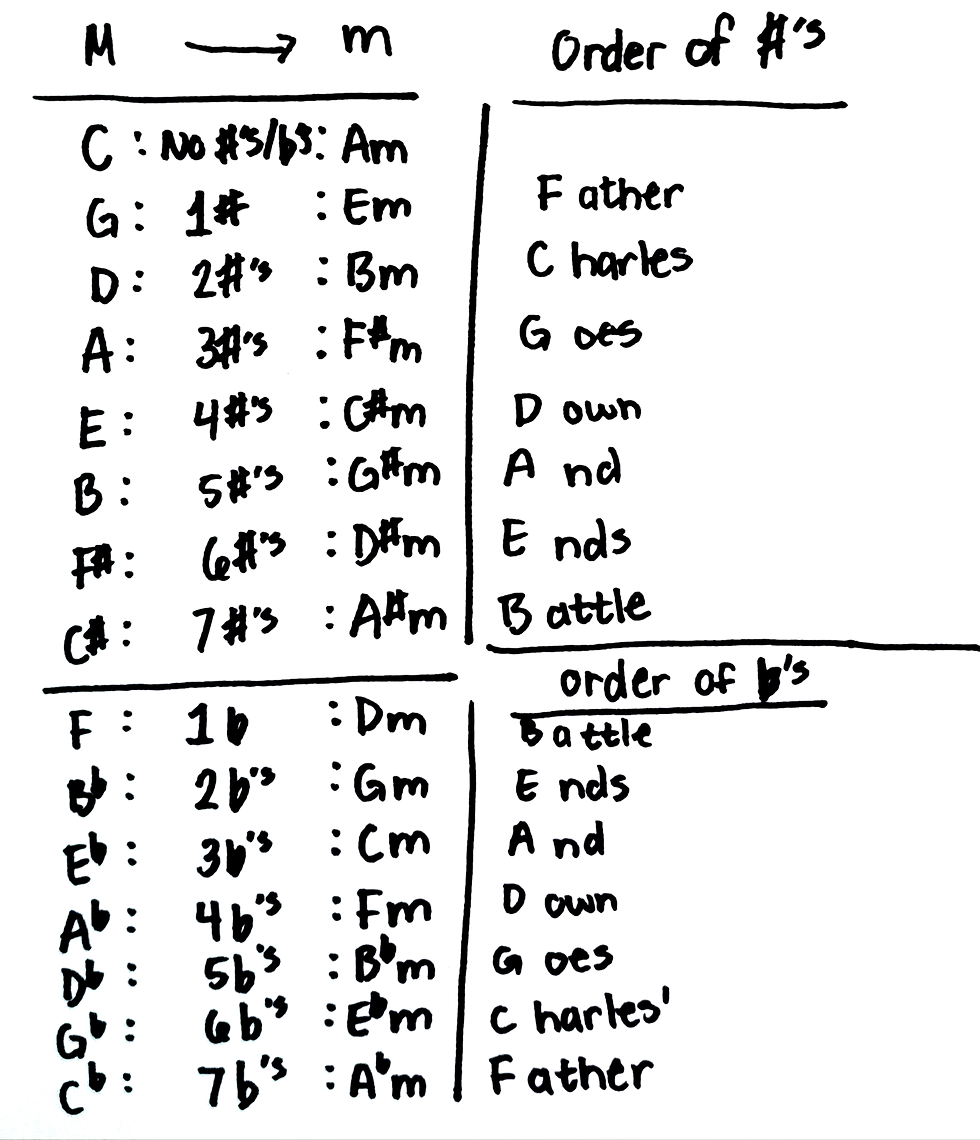
In this list I also give you each major scales relative minor, along with how many sharps or flats it has, on the left hand side. On the right you will see the order of sharps or flats.
For example, for the G major scale it says it has one sharp and that sharp is the F#. For D major it has two sharps which include the F# and C#. For A major we have three sharps which are F#, C#, and G#. Same rule follows for flats, F major has one flat which happens to be Bb. Bb major has two flats which happen to be Bb and Eb. Then Eb major has three flats which are Bb, Eb, and Ab.
4) How do we write key signatures on a staff?
We write key signatures on a staff by following the order of sharps and flats.
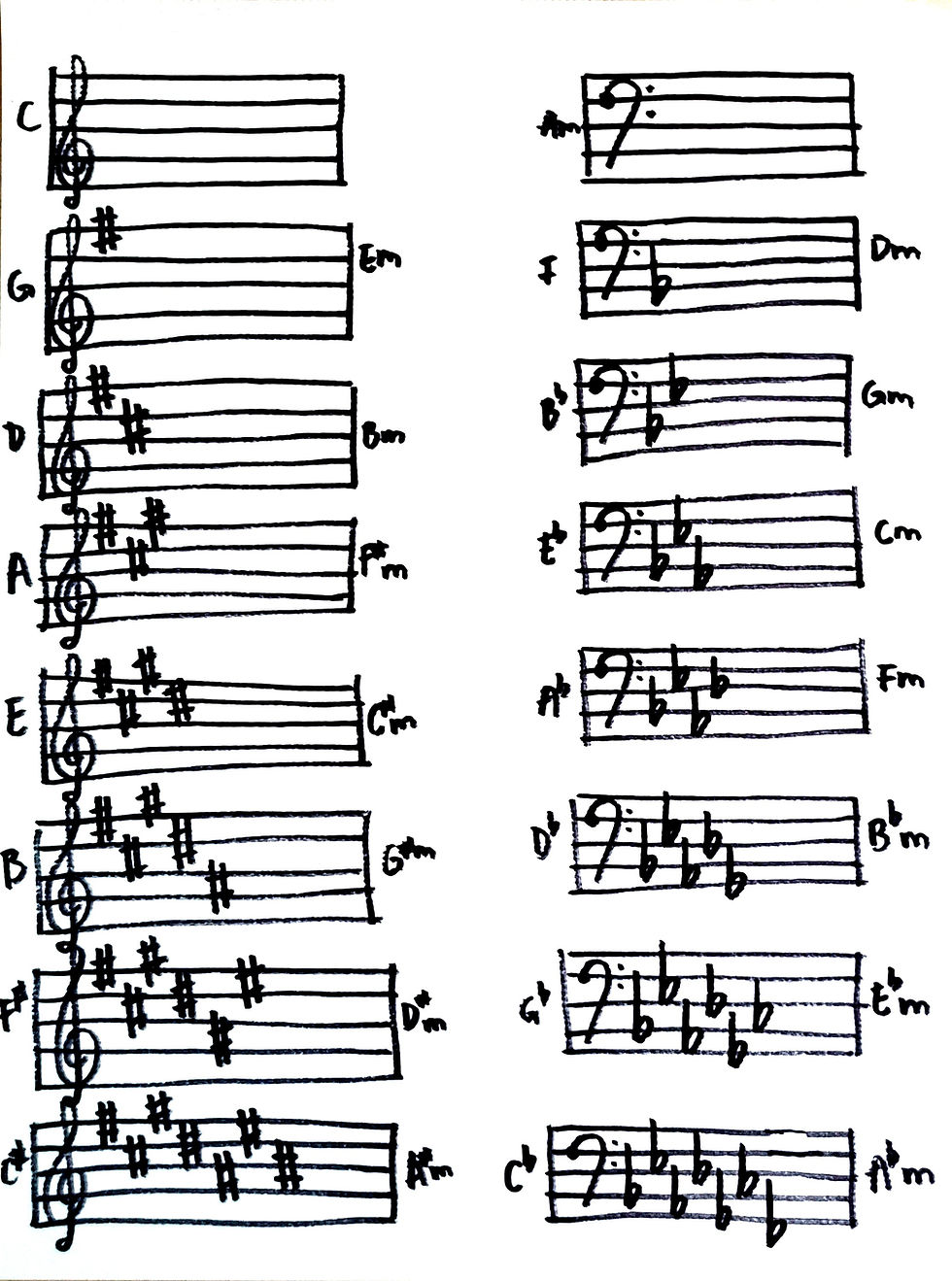
The visual on your right demonstrates how we write our key signatures on a staff according to the key (or scale) being used. Each follow a particular pattern.
If you look at the sharps, in particular C#, you can see how there is a pattern of 2, 3, 2 that it follows whereas if you look at Cb, it is almost like a musical trapezoid in its shape that is created by having three flats going parallel to the four flats below them.
A big reason why it is written this way is to prevent clutter and to make it visually easy for the musician to read sheet music. Not only does it make it easier but by having the accidentals written at the beginning, which we know as key signatures, we can figure out in what key we are going to playing in, which I feel mentally prepares for what we will be playing.
EXTRA RESOURCES
Here is a fun game to test your knowledge on key signatures. Just follow the link and happy practicing.


Comments